Can a Machine Be Conscious? Checking Out 200 Theories!
DeciBio hosted another fascinating dinner in London 3 weeks ago, and obviously we had to talk about AI. And with Jacob Coxon very publicly leaving Anthropic over AI safety, it feels like a good time to share this interesting analysis about whether AI can shortly reach consciousness. In my opinion, it can — there is nothing particularly special about the wet nature of the brain (to use Sam Harris' words) that would prevent consciousness from emerging in another system that is silicon-based, if you believe that it arises from the parallel processing of information.
So when someone at dinner mentioned Robert Lawrence Kuhn's "A Landscape of Consciousness" — a beefy 142 pages, open access, distilled from a neurophysiologist's lifetime and two decades of Closer to Truth interviews with more than 200 thinkers — I had to take a scan of the whole thing. I concede it's too dense to read every word, so in a very meta way, AI synthesized it for me!
A few conclusions:
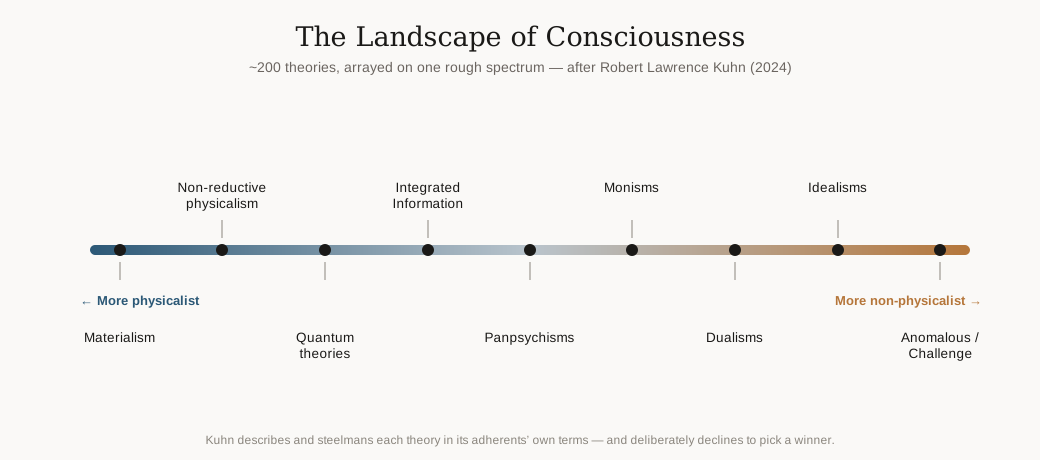
1) A map, not a theory: Kuhn offers no theory, but rather gathers ~200 of them and arrays them on one rough spectrum — hard physicalist ("the brain is a machine, and mind is what it does") to fully non-physicalist ("consciousness is fundamental, and matter is the puzzle"). He declines to take a stance. His aim is to gather and categorize. He is just dodging! :) But it's an amazing map.
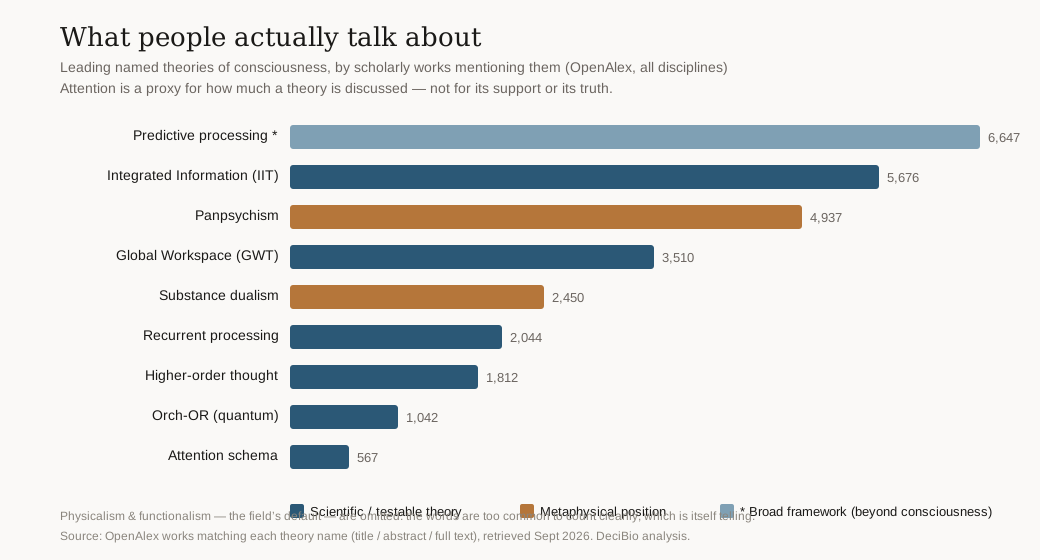
2) Not all points are equal, though: So I measured attention (OpenAlex, which is more of a proxy for oxygen than truth). IIT (Tononi) and Global Workspace (Baars, Dehaene) anchor the opposite ends. The fun surprise: panpsychism is discussed as heavily as any scientific lab theory! And it isn't a fringe of cranks: Max Planck flatly declared, "I regard consciousness as fundamental," with matter derived from it, and Schrödinger agreed. (Caveats, on the chart: attention isn't correctness; and physicalism/functionalism, the "default", is too established to count.)
3) The wall everyone hits: We can explain how the brain files a wavelength under "red"; no theory explains why there's something it is like to see it. As Nagel put it, without consciousness the mind-body problem would be far less interesting; "with consciousness it seems hopeless." This is where our day job humbles us: we live in a world obsessed with measurement (e.g., genomes, tumors, millimeter imaging) and measurement is exact in our space. But in contrast, you can chart every neural correlate forever and never catch the experience itself.
4) Where I've landed (loosely): A cautious functionalist — "it's just computation" is weak, because as far as we can tell, so are we. And I'm panpsychism-curious: "consciousness is fundamental" at least dissolves a problem that "it emerges from complexity" merely relocates. The least crazy of the crazy options.
So: can AI be conscious? Here the map earns its keep: Kuhn notes the question has burst into public view with ChatGPT / Claude and become a serious matter of global concern. The soberest answer he cites (a 2023 multidisciplinary report) ran the leading theories against today's systems: no current AI is conscious (that we can actually detect), but there's no obvious in-principle barrier to building one that is. If functionalism holds, it's possible, and we're building the substrate now. We may be building systems that pass every behavioral test while we stay unable to verify whether the "lights are on". Kenneth Steiglitz goes further: it may be impossible to test for consciousness at all.
Mark Solms calls building artificial consciousness the ultimate test and warns we must "proceed with extreme caution." We're about to mass-produce entities whose inner status we can't check, using a science that admits it can't check it.
Source: R.L. Kuhn, "A Landscape of Consciousness," Progress in Biophysics and Molecular Biology 190 (2024): 28–169 (open access, CC BY-NC-ND). Theory-attention counts from OpenAlex, retrieved September 2026.