
My Prenuvo Scan and the Consumerization of Prevention
Last week, I did my first Prenuvo full-body scan. Thanks for the referral, Carl!
This will surprise exactly no one who knows me: I am a bit of a sucker for these things. Full-body imaging? Whole-genome sequencing (WGS)? Microbiome testing? If there is a new way to look under the hood, I am probably somewhere in the queue, intellectually curious, commercially interested, and only mildly embarrassed by how excited I am.
The experience was impressive. The process felt modern, consumer-friendly, and frictionless for something that usually sits inside the intimidating healthcare machinery. The results were also genuinely informative. Thankfully, nothing serious came up - just a handful of benign observations, the kind of things that are useful to track, and perhaps discuss with a physician, but not the sort of findings that ruin your week. And the turn was quick: first contact on 2/7, scan scheduled on 2/11 and results on 2/18!
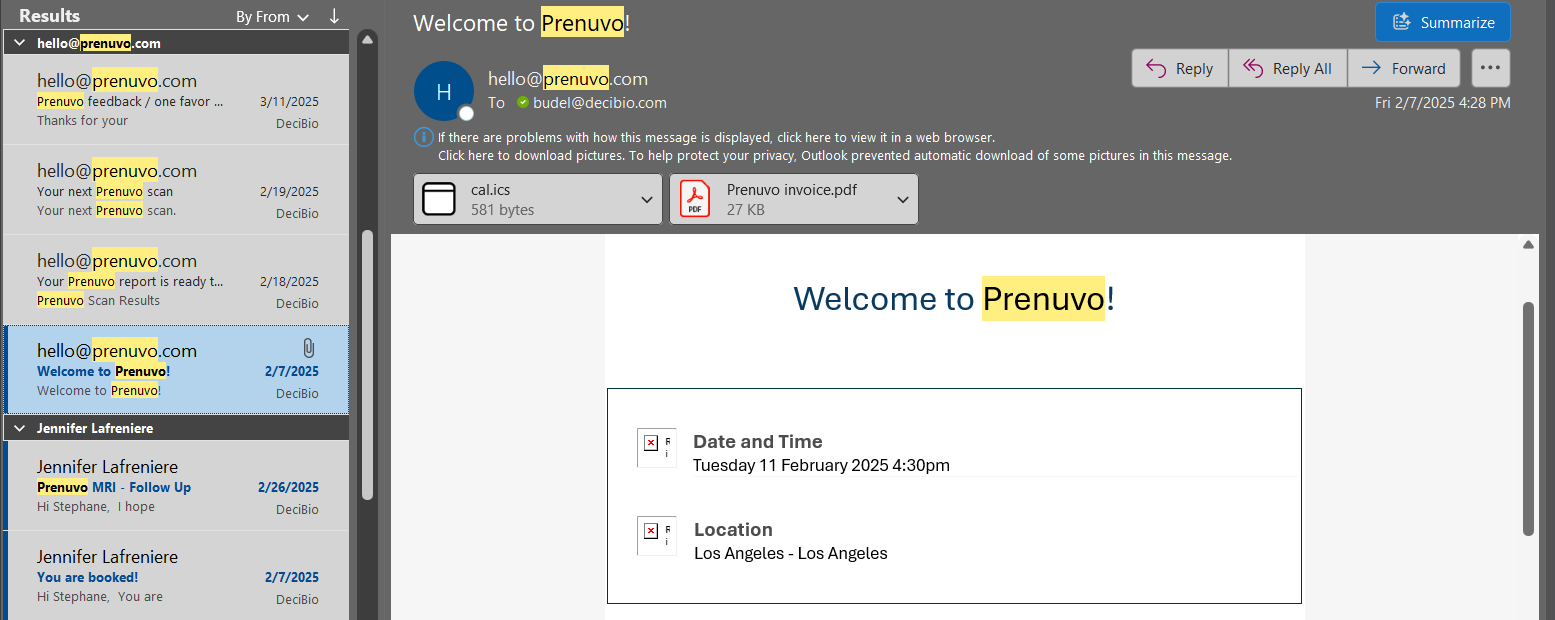
That, to me, is the bigger point: We talk a lot about the shift from sick-care to healthcare. Usually that conversation happens at the system level: payors, providers, pharma, diagnostics companies, and everyone else trying to redesign a system that often seems optimized to intervene late, bill heavily, and then wonder why outcomes are expensive.
But the shift may also happen from the consumer side. As commercial solutions become more available, more affordable, and easier to access, people will increasingly take pieces of preventive care into their own hands (if they can afford it), because they are tired of waiting for the healthcare system to become proactive. If a consumer-facing service can deliver useful information at a fraction of what the same experience might cost once folded into our bloated sick-care machine (call it 10%, directionally; $2.1K for my MRI scan) that is not a gimmick!
It is a challenge to the system! Healthcare has historically been very good at making simple things complicated, expensive, and emotionally taxing. Consumer health companies are starting from the opposite direction: make the experience simple, the interface clean, the data accessible, and the follow-up understandable. Hopefully this means that the bar for user experience in healthcare is being reset from the outside!
One slightly uncomfortable observation: my Prenuvo experience was more immediately informative than my WGS experience ten years ago through Illumina's "Discover Your Genome" program. As someone who has spent a career believing in genomics, I say that with love, and a small wince. Because #NGSisUnstoppable, obviously.
To be fair, WGS reporting has likely improved dramatically since then: better interpretation, better databases, better clinical workflows, better integration with family history and phenotype. But at the time, the WGS experience felt more like receiving a beautiful encyclopedia written in an extinct language. Fascinating... But not exactly actionable!
The scan, by contrast, felt concrete. You could see things, and seeing is believing! You could easily understand findings. Imaging has a storytelling advantage: the body becomes legible in a way genomics often still struggles to achieve for the average person.
I had a similar, though less transformative, experience with Viome. It was interesting. I changed my behavior a bit for a couple of months based on the recommendations. But I cannot honestly say I noticed a major difference in my health. I'm still a fan of the microbiome but we should be careful not to confuse "interesting biological signal" with "life-changing intervention" at this point. Perhaps it can be more useful for folks with GI issues.
And, speaking of humility: I did all of these advanced tests before finally doing my colonoscopy (almost 5 years after it was due). There is probably a lesson in there. Maybe the future of preventive care is not choosing between old and new, physician-led and consumer-led, colonoscopy and full-body imaging, genomics and radiology, diagnostics and wearables. Maybe the future is building a smarter stack: proven screening where it exists, emerging tools where they add value, longitudinal monitoring where it makes sense (love my Apple watch!), and physicians who can help interpret the flood of information rather than simply react to disease once it appears.
That is the world I am excited about: A healthcare system that sees earlier, and a consumer who is more engaged! A diagnostic ecosystem that is valued for preventing downstream cost, not just confirming downstream disease.
Prenuvo felt like a glimpse of where healthcare is going: more proactive, more consumer-friendly, more data-rich, and hopefully a lot less allergic to prevention. The irony, of course, is that the most advanced version of healthcare may look less like a hospital and more like common sense with better technology. Which, given where we are starting from, would be a major innovation.